What’s In A Name?

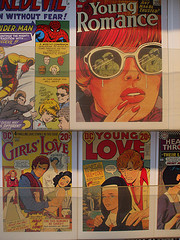
                          Romance Comic Postcards from PinkMoose

Okay, by name I actually mean genre. It’s my bete noir and as I find myself writing a new WIP, the subject is stirred once more to muddy the waters.
For example, my novel ‘The Divine Pumpkin’ which is due out mid-May, has been placed in the fiction-drama category by my publisher – Winter Goose. Yet one agent wrote to me saying that the novel was a good mix of women’s fiction and crime. It is about an incarcerated young offender, but I wouldn’t class it as ‘crime’. It also explores the inter-personal relationships between people, but it isn’t a pure romance or women’s fiction. When people ask me about my novel, I don’t name a genre, I just tell them a brief synopsis. And on many levels, it is a drama.

Now my next novel, which is due out in Feb 2013, is more of a psychological thriller with, again, an examination of inter-personal relationships. Again, fiction-drama could be a very fitting genre for this novel.

My fear is that my novels may slip through Amazon & Barnes & Noble’s nets as they don’t sit purely in a romance, crime or thriller genre. They are a melange and that’s what I enjoy writing. So why stop?
I also worry (which seems to be a hobby of mine lately) that the genre of fiction-drama won’t catch the eye of the reader seeking a new novel to devour. Only time will tell.

I’m starting a new novel about a group of very different people who all have one things in common, which impacts on the way they interact. I find stories like these fascinating, much as I do when I’m people watching in cafes.

I believe that if I wrote solely for commercial viability, ie. to sit squarely in a particular genre, then my novels wouldn’t be written from my heart, they’d be written with a monitory  value attached to them. Although that would be a very welcomed facet, I didn’t start writing with that goal in mind. Personally, I write for pleasure, passion and a need to feel words on paper. The characters from my novels live in my head when I cook, iron and wash-up, and I hope that they dwell as easily in the minds of any future readers.

Are genres there to simplify things for the publisher, author or reader? Quite often when I pick up a book in a shop, the book is named solely as fiction, on the back cover. I choose the novel because I’m hooked by the blurb on the back.

As the release date is getting closer, perhaps my insecurities are surfacing, making me question the whole phenomenon of genre, labelling, and tagging, because I’m worried that no one will notice my work in amongst the 8,000 new novels that are published each year in the UK (Nigel Watts, 2010. Write A Novel and Get It Published.)

Perhaps I’ve made this issue too big in my mind, and some of you reading this will wonder why I worry at all. Genre is just a name, like my name and your name. What’s important is that the novel has a great story to tell, in whatever genre or sub-genre, just like it’s important we are a caring human being, not just someone with a beautiful name.

Happy Word Flow One & All.

What does being a writer mean?

        Photo: Words from Southernpixel Alby.

Do we learn to become a writer, or is it it something that comes naturally? Do we possess some internal genius, or do we need various qualifications to prove our worth? I have read numerous books on writing and no one has the miracle answer or formula that would ensure our success. So where does that leave us?

Well firstly, I believe that to write a novel, a writer needs a vivid imagination, somewhere for the first flame of     the story begins to flicker. We then need the ability to blow gently on the flame to ignite the story into some form of outline. The stage of the roaring fire fleshes out the characters and layers the plot line with enough  sub-plots to interest and hook the reader. The embers that remain fuel our imagination to move onto the next novel.

We also need the tenacity to complete a novel, as there can be mid-story slumps and blocks in our minds that interrupt our creative flow. Periods of anxiety, where we feel our writing is inadequate, can often assault our confidence, and yet we push through and persist in our quest to produce  novel.

Being a writer also implies that we observe life and preserve the things we see, hear, taste, touch and smell, in order to relay them to the reader via our fictional world. We become wordsmiths of the universe. We dilute our machinations into novels of all genres, in the hope of entertaining readers of every age.

As a writer, we need to be avid readers. We need to immerse ourselves in the written word of others to see ho the words shape well together, or not, as the case may be.

Being a writer doesn’t come with bells and whistles attached (as I thought would happen when my publishing contract came through!). It’s a quiet unassuming role which is nurtured within us, growing in us like a blastocyst which eventually develops into a baby.

The other day, a man repairing our satellite asked me what I did, and I said I was a writer. He looked surprised and wanted to know more. I found myself feeling rather shy about handing him a business card, but my publisher would be proud! Apart from making myself know on the web, I need to get myself known locally, as local writers can often spark an interest in the community. So don’t be shy folks, be proud!
The engineer asked me to mention him on my blog, so for those of you in the south east of England, if you need a telephone, fault finding, broadband issues or Internet cabling, check out Tom Hailes, Telephone engineer at http://www.thcontracts.co.uk

Happy Word Flow One & All.

Find Your Own Style

Photo: Romance from Ms.Lume

I will often read a novel and be swept away by the author’s style of writing. Their choice of words and fluid prose will often make me query whether I’ll achieve such prowess.
But as a writer, I mustn’t recreate another author’s style, I must find my own. And how do I do that? With a lot of practise; writing over and over until I see my personal stamp in the form of style, emerging from the page.

But I have to practise in a certain way, without forcing the issue. Style has to come naturally and not be forced onto the page. I use words that I would normally use, although I do try to be more eloquent at times. My Editor, however,  may suss me out and vote with his Red Pen should I try to be too clever!
Using words that come naturally allow the sentence to flow from my fingertips without having to consult the thesaurus every few lines, which would jar my concentration and creative flow.

This philosophy will also ensure a better flow for the reader, as they won’t require a dictionary to get through the pages of my novel. I’m not saying that the reader is an uneducated fool, but rather I see the reader reading my novels for pleasure and relaxation, rater than an exercise in increasing their vocabulary.
This, of course, may be behind the concept of writing a literary novel – but here I’m just speaking for myself. Of course reading on a Kindle has made looking up a word in the dictionary very easy – albeit an interruption of the flow.

Brevity is an essential component of style. This means using less words to say something in order to move the story along. Those of you that know me personally will know that I’m a verbose person – hence my disenchantment with writing short stories! I know I’m prone to over write the emotional aspects of a character, due to my professional background.

To draw this to a conclusion, (for now, as there is so much more to say about style, for another post) I would say have confidence in knowing that your own style will emerge if you don’t force it.
Let it bubble to the surface, like the bubbles in a glass of sparkling water.
Have faith in yourself as a writer and don’t be afraid to make mistakes.

Happy Word Flow One & All

Lucky 7: seven lines from new works

I have been passed my Lucky 7 by the wonderful Laura Wilkinson. Lucky 7 is a bit of ‘blog fun’ for authors.
This is my first time being tagged, and as I pass this on to my Lucky 7 – like Laura – I hope i don’t lose any friends or followers 🙂

Here’s how it works:

– Go to page 7 or 77 in your current manuscript
-Go to line 7
-Post on your blog the next 7 lines, or sentences, as they are – no cheating!
-Tag 7 other authors to do the same.

Here is the 7 line extract from page 7 of my current editing manuscript ‘The Divine Pumpkin’:   


“God, I don’t believe you! Of course power is important. I don’t have it and everyone else does!” She raised her voice so loudly that a prison officer peered through the
 glass window in Paloma gently raised her hand to him, and gently shook her head.

                                                . . .
Paloma had a forty-five minute drive to her home in Cambridge from the YOI, which offered her the opportunity to indulge in two guilty pleasures; listening to The Mama’s and the Papa’s and smoking. She knew the latter action was moronic and inexcusable, but she loved the way it made her feel. Rebellious and relaxed.

As I wrote this I noticed something I need to change, but as the rules state ‘no cheating’, I had to obey!

So the next Lucky 7 are:

Mariam Kobra @marium_kobras
Lyn Midnight @LynMidnight
Robert James Russel @robhollywood
Helen Hollick @HelenHollock
Kate Thomson @Katyhaye
Sean Harris @vampirewars_SH
Amanda McCrinn @9inchnails


Remember that this is a bit of fun. I have enjoyed reading the previous 7 extracts, and hopefully you will have the same experience. There is no punishment if any of the Lucky 7 above don’t partake.

Hope you enjoyed my extract 🙂

The Divine Pumpkin COPYRIGHT c 2012 by Hemmie Martin
Excerpt appears courtesy of Winter Goose Publishing

‘Lessons From The Monk I Married’ – review

I was lucky enough to have been asked by Katherine Jenkins’ publicist to review her book ‘Lessons From The Monk I Married, which is out today – 3rd April. 
The book is name after her blog which goes by the same title – a blog I recommend you visit if you haven’t already. Both offer inspirational reading which is sometimes good for the soul.
My 17yr old daughter now wants to read this book, in between studying for her A levels, volunteering and her social life. This book may give her some precious wisdom and food for thought.
Below is the review I sent to Katherine’s publicist. It was an honour to be asked and I wish Katherine much luck with her book and all that goes with it. 

Review of ‘Lessons From The Monk I Married’ by Katherine Jenkins

This book exceeded all my expectations, by offering an insight into South Korea, meditation, adversity and love. I could see and smell the sights and local cuisine as though I was travelling with Katherine Jenkins on her journey.
The book is divided into Lessons which lead us through the complexities of life, allowing spirituality, yoga and Buddhism to cast a powerful light on events, as well as Katherine’s own views.
Katherine’s tenacity at overcoming hardship and believing in love that is truly meant to be is both inspirational and moving.
On finishing the book, I was left feeling spiritually uplifted with a renewed zest for life. The memoirs of Katherine Jenkins are an experience you won’t forget.
Hemmie Martin, author of The Divine Pumpkin.
I hope that you are all enjoying your world of writing and that you are riding the highs and lows with equal strength. My novel will be published next month – how time flies – and I’m feeling a host of fears and emotions I haven’t experienced before. That may be a post for the future.
Happy Word Flow One & All

The cover of Katherine’s book.

See the Editor as a wise friend

Coffee from Stepheye

That’s how I perceive my Editor, as I sit with a coffee at my laptop. However, working with an Editor is harder than I imagined. He scrutinises ever word and detail, and then asks me to re-word, re-write or remove it completely.

I always wondered how it would feel when an Editor would put lines through my work. Now I’m at that junction I find that it’s not as bad as I imagined. Yes, he may discard some prose I’m proud of, but I can view it from a reader’s point of view and see that it’s surplus to requirement. It doesn’t move the story along.
I don’t know whether this is normal, but after reading my novel six times so far, I’m almost tiring of it. I push through this and then I find something I’d forgotten about allowing it to carry me along like a feather in a storm. I’m suddenly revitalised.
Working with a Editor means I’m getting an honest view of my work. He makes me criticise and amend my words until it flows more readily for the reader. But he also energises me. His enthusiasm is like a cold hand on a fevered brow, and I welcome his emails with only a soupcon on trepidation.
Everyone has talent. What is rare is the courage to follow that talent to the dark place where it leads.
                                                                                                             
                                                                                                                              Erica Jong
Happy Word Flow One & All, and welcome to the new followers.