Something Worth Doing Is Always Hard

Whether it’s restoring an Arrnstrong Sidley (as William is above), training for the Olympics, reading ‘War and Peace’ or losing/gaining weight, every endeavour demands that we put a lot of effort into it. My eldest is planning on going to university next year to train to become a vet. There is a shortage of places, so she requires the top grades possible, as well as experience in vet establishments, lambing and farm animals, to mention just a few. A lot of effort is required, but the job will be worth it in the end. My other daughter wants to be a maths teacher in a secondary school – now there’s a challenge!

And writing a novel is no different. You conceive the idea, plot and plan it, write the first draft which you then re-write, then edit, edit, edit…

And after the novel is finally written, you have the synopsis and query letters to produce, and then you have to cope with rejections, only to push yourself out there once more.

So you finally find an agent or a publisher, and then the work load cranks up a gear. Not only do you need to find the time to write your next novel, you have to link with the world via social networks (being careful not to just promote your novel), write a blog and be interviewed for other blogs (which you reciprocate). You have to remind people periodically that you and your novel still exist, in a virtual world that is littered with authors and novels. It’s a murky world, and if, like me, you don’t have an endless pot of money with which you can buy advertising, you have to be creative and work even harder.

I don’t want to put you off, but producing a noel is a bit like having a baby. Everyone tells you a baby will change your life, but you don’t realise it until your hold the gurgling child in your arms and then take them home – scary! Having a novel requires almost the same amount of dedication as a baby. To raise it to it’s full potential, well rounded, well structured, loved by many and hated by few self, the parent in both senses requires to work hard, even on those dark days. And just like a parent, you need to attend classes, conferences and discuss the process with other people who are going through the same experience.

Well, this parent has linked with the virtual world, but now needs to be a parent in the real world and go and feed my (teenage) babies.
 But before I go, may I draw your attention to the link to my novel ‘The Divine Pumpkin’ at the top right of this page. I believe this is the first time I have so shamelessly plugged it, but I mustn’t shy away from this opportunity seeing as it ties in with this post!

Welcome to the new followers – I appreciate your support

Happy Word Flow One & All

How I Coped with Rejection

Chocolate from John Loo
This topic is rarely touched upon when writers are seeking representation or a publisher. A case in point, I wrote about rejection last year and only one person responded to the blog post. However, it’s a topic that touches all of us at one time or another. So how did I cope?
Firstly, as I read a rejection letter or email I would feel despondent and low in mood for a short period of time. I never cried and I was over the negative feelings by the following day. But it did knock my confidence, even though I knew rejection was part of the writer’s journey. A bit of chocolate also helped – for medicinal purposes only, you understand. 
I would send out more query letters, perhaps amending them slightly, but after receiving say 5-7 rejections for one novel, I would shelve it and begin a new novel. I had quite a library after a while! When a received encouraging feedback from several agents, I would take their comments on board and work accordingly.
I never stopped writing, even when at times I doubted my abilities. I read countless books and observed how the author engaged the reader. I noted what worked and what didn’t work.
I never threw work away. For example, I had this novel wrote about two years ago, which a couple of agents had told me was ‘nearly there’. I felt passionate about the story, and so once I had a publisher, I decided to edit it once more before sending a synopsis to them. To my utter delight, they are publishing it next Feb! My point is, you may have already written a publishable book, but you may not have found the right person to appreciate it. So don’t toss rejected novels in the bin. Keep them, use parts of them, re-write them, editing them further, in other words, keep working until you have something truly special on your hands. You will get there eventually.
Happy Word Flow One & All

If in Doubt, Leave it Out

Books to be returned by hashmil.

I’ve been editing a novel, but all the while, a voice has been interfering with my word flow. It tells me that the novel isn’t good enough and that some magic ingredient is missing. Now if I’m unsure about a story, how can i expect the reader to be enamored with it. I don’t normally give up like this, but the voice was too strident to ignore.

But I need courage and conviction to discard something I have invested many hours in. Some of the phrases excite me, whilst others make me smile. But overall there lingers disappointment in my soul. Where did I go wrong? I feel the sub plots are insipid and the characters lack some attributes that are necessary to love and loathe them.

It’s not a case of killing my darlings, but rather annihilating the whole community. Am I brave enough?

Over the past few days an idea has been burgeoning in my head, and I’m warming to it. So far I only have the bare bones of the story, it requires much fleshing out before I can commit to it. I don’t wish to find myself in this position again. How many hours can I truly waste?

Of course I’ll keep the last novel as I may be able to salvage something from it further down the line. But for now the file is firmly clamped shut.   Long live the new WIP!

I hope the Words are truly Flowing for you, dear One & All..

One Lovely Blog Award

This is a first for me, and I’m thrilled to have been given this award by the wonderfully talented R.M. Wilburn, author of the brilliant Buggy Crenshaw Adventures : 
And now for the responsibilities that accompany this prestigious award.
1) I am to share the link of the person who honoured me with this award – thank you R.M!
2) i am to nominate 15 more lovely blogs for this same honour (see below).
3) I am to relay 7 things about myself  (again see below, below)
My winners in no particular order are:
Jessica kristie  http://jessicakristie.com
Louise Hastings  http://louisehastings.net
Congratulations One & All.
And now for the 7 things about me:
1) I am addicted to jelly beans.
2)I don’t communicate well in the mornings unless I’ve had a mug of coffee.
3) I would be  neat-freak if my family and pets allowed it.
4) I won the first ever mummy-race at the brand new primary school my daughters attended.
5) I have a ‘soft-spot’ for Greg Davies.
6) I love chocolate spread and peanut butter.
7) As a child, I played the clarinet, recorder, piano and guitar. None of them to a high standard, but in my head I sounded marvellous.
So there you have it. I would like to thank R.M.Wilburn again for honoring me with this award. I will display the badge proudly!

Recipe for a Novel

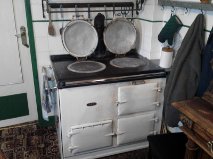
                                            My uncle’s Aga

Writing a novel is rather like cooking. Both need a list of ingredients and a method to put the elements together to produce a successful outcome. Sometimes whilst cooking, I try different ingredients or cook without a recipe. Sometimes that works and other times I need to throw it away and go and buy a bag of chips.

There are basic elements to writing a novel that cannot be over-looked, and I’m revisiting them now because I feel I’m going astray in my current WIP.

The novel follows the curvature of an arc. It starts with the situation at the start of the novel which has the task of hooking the reader, agent or publisher. It sets the scene for the reader before moving onto the trigger which sets the story-wheel in motion.

Once the story is in motion, the protagonist is given a quest of either seeking something, changing something within society or within themselves, or finding something or someone.

During this quest, something unexpected must happen to hinder the protagonist’s progress. This can add an element of surprise or frustration for the reader – and sometimes the author!  This can cause the protagonist to do something out of the ordinary for themselves or cause them to make a mistake, worsening the original situation. This worsening leads to a climax, pushing the protagonist to their moral or physical limits.

The climax then leads to a shift in the original situation, where now the reader finds calm, restitution and a satisfying – or not, as the case may be, genre wise – conclusion.

My current WIP has plenty of sub-plots, but I’m not convinced that my protagonist’s journey is strong enough for the reader to care about. If I’m not convinced then how am I going to convince the publisher that my novel is worth printing? I have interesting character’s and a common denominator that brings them all together, but there is an ingredient missing and I need to discover which element I have left out. Some days this quandary stresses me and I feel defeated, whereas other days I am spurred on by the challenge, knowing that sooner or later the recipe will come together to form a tasty story.

I hope that you find yourself cooking tasty stories that tickle your taste buds.But if you need to tweak the recipe, fear not, we all need to add a pinch of something at one time or another.

Happy Word Flow One & All

Evoking Emotion

                              Photo by Bubble Head H_W

When I’m looking for a novel to read, I’m actually looking for something that matches my mood. For example, if all is feeling rosy for me, I may seek a novel in the romance genre. Sometimes when I’m ambivalent, I’ll trawl the bookshelves in a book shop and see if any of the covers catch my eye.

I find that I also listen to music that corresponds with my mood. As I’m writing this, I’m listening to Vivaldi’s Four Seasons which I find to be an upbeat classical sound. So know you know what mood I’m in now!

There are many descriptions to show emotion – biting the lip, reddening cheeks…But they are descriptions that show what’s happening ‘outside’ the character, rather than what’s happening ‘within’. Of course we can use – quickening of the heart beat, dizziness…But what about using symbolism?

We can use symbolism such as rain drops weaving their way down a window pane to mirror the sadness within a character. Fear can be induced by a foggy night, the child-like shrieks of foxes or a thunderstorm. These already have meanings attached to them so the reader can relate to them immediately.

I like to use the contents of a women’s handbag, the state of a garden or house to help define a character and how their life feels to them. For example, the constant returning of dust on a mantelpiece  can demonstrate hopelessness.

I also like to use smoking or drinking to demonstrate a character’s weakness in coping with adversity or stress. Hence, when a character lights a cigarette, the reader comes to recognise that the character is stressed or troubled without me actually using the word – they can see it for themselves. I am aiming for the emotion to emerge from the page by using settings, objects or atmosphere, rather than just stating the physical feelings of the character.

However, I do still use phrases such as ‘his heart pounded in his ears’ because I feel there is a place for such phrases as long as they aren’t over used. Early on in the novel, I try to link such phrases with objects or habits so that later i can just use them and the reader is ‘right there’ with the character’s emotion..

Every time I write a new WIP I try to develop these skills further to hopefully reach the reader in an improved way. The best thing to do with all these elements of  writing is to keep writing, keep reading and keep believing.

Happy Word Flow One & All